Agentic analytics · for payments analytics teams

Reroute before the volume is lost. The cause before risk escalates.

When approval rate drops on an acquirer, Bicycle checks where it moved, ranks the issuer-cohort decline against the routing rule, and attaches the evidence, so your team reviews instead of rebuilds.

Cursor multiplied what one engineer could do. Bicycle does the same for your analysts.

No credit card required

app.bicycle.ai checkout · use-case agentAgent live
Alert · Conversion
Approval rate · Acquirer B-2.7pp

One acquirer cohort drifted before the blended average moved. Detected at the segment, not after the day closed.

SegmentAcquirer B · EU debit
vs 7d avg-2.7pp · governed approval rate
Detected09:58 · automatically
Detect Explain Review
The operating model is breaking

The force multiplier for your payments analysts.

Faster onboarding, fewer repeat investigations, and decisions backed by evidence, with your team governing every definition, answer, and action.

Without Bicycle With Bicycle
repeat
The same payment questions come back to your queue every week
Approval rate slips on an acquirer, a decline cohort spikes, settlement lags, and you re-cut the data, rebuild the drivers, and reassemble the evidence from zero.
reuse
You build each investigation once, then reuse it
Tune the driver tree once; Bicycle reruns it every time approval rate moves, with the evidence already attached.
sprawl
Every new acquirer and corridor adds more to model
More gateways, more KPI definitions, more dashboards, more ad-hoc "why did approval drop?" asks landing on your queue.
one model
New acquirers inherit one governed model
New acquirers and corridors inherit approved KPIs, patterns, and cause paths instead of starting from a blank cut.
shadow
Payment ops builds shadow analytics while it waits
Side spreadsheets and ad-hoc queries on approval and decline rates, with no lineage, no review, no shared definition.
self-serve
Payment ops self-serves inside guardrails
They get answers with lineage on the KPIs they own; you keep definitions, permissions, and actions governed.
blamed
You own the number but get blamed for the delay
Accountable for whether the approval-rate number is right and for clearing the queue, at the same time.
both
Trusted answers, delivered faster than the asks arrive
The recurring queue moves faster than the questions come in, and every published answer is defensible.
The capabilities

One governed system, six capabilities behind every answer.

Set up once, run continuously. Each capability is reviewable and governed by your team, so the business self-serves on a number it can trust. Pick one to go deeper.

Rapid activation on your stack

Every initiative starts with source discovery, modeling, KPI cleanup, and dashboard setup. The business waits while you rebuild the basics.

What Bicycle does

1

Connect existing data. Reads from your warehouse, streaming, and databases. No migration project.

2

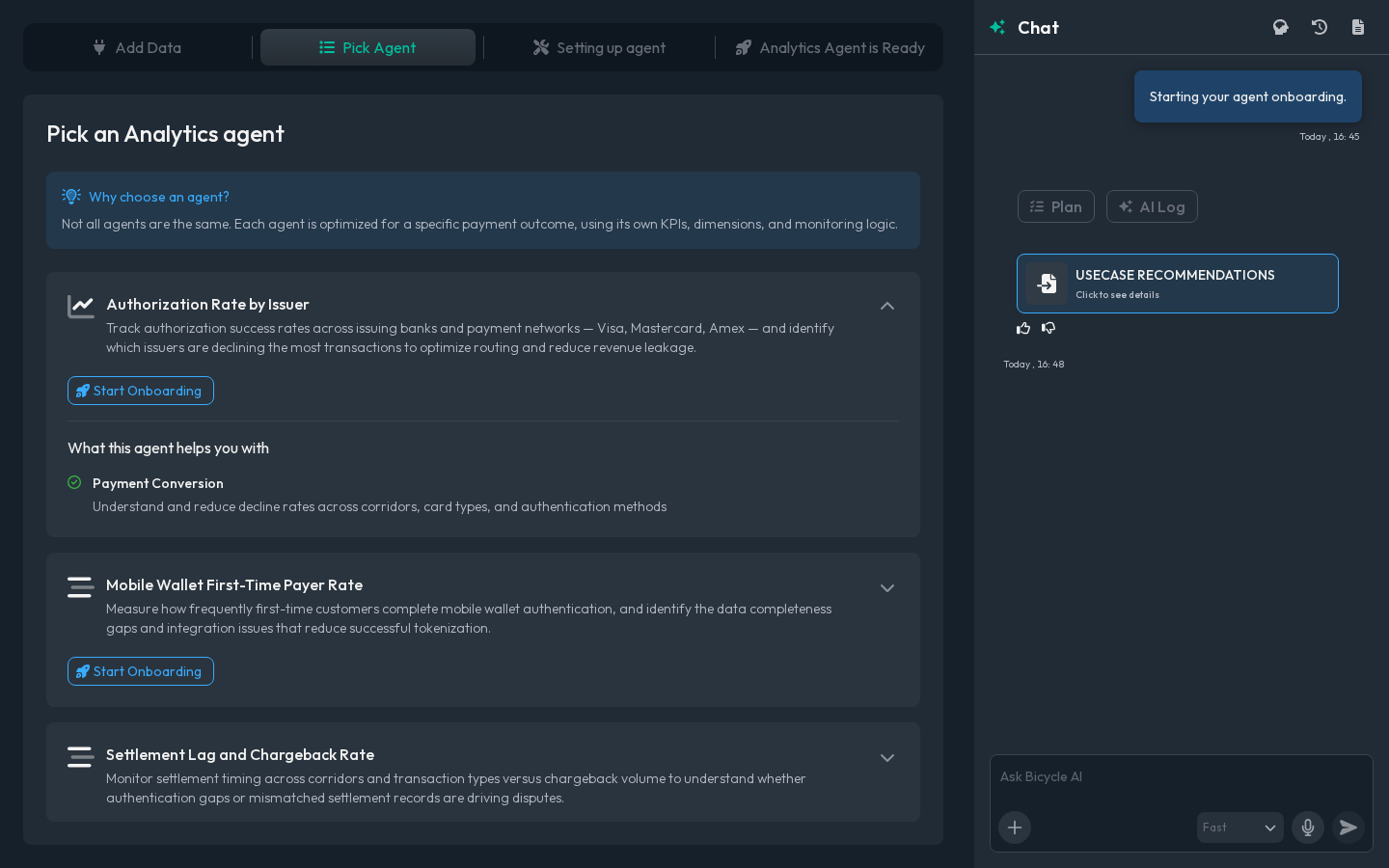
Generate the first system. Proposes events, dimensions, KPIs, and a starter use-case agent from your stack.

3

Make setup reviewable. Approve, edit, or reject every suggestion. Gaps surface as TODOs, not hidden work.

In practice

Connect Snowflake, dbt, and your gateway, issuer, and settlement feeds, apply the payments pack. Bicycle proposes 40 KPIs across approval, decline, and settlement; you approve 35, tweak 5. First agent in days.

Capabilities work together in one continuous loop. Detect → Explain → Act → Learn.

The playbookBuild · Tune · Govern

Your team builds the intelligence layer once. Bicycle runs it, tunes it, and lets you govern it as it scales.

Buildthe trusted foundation
Tunethe intelligence layer
Governself service and safe actions
Pillar 01Build the trusted foundation

Onboard once. Review what Bicycle drafts.
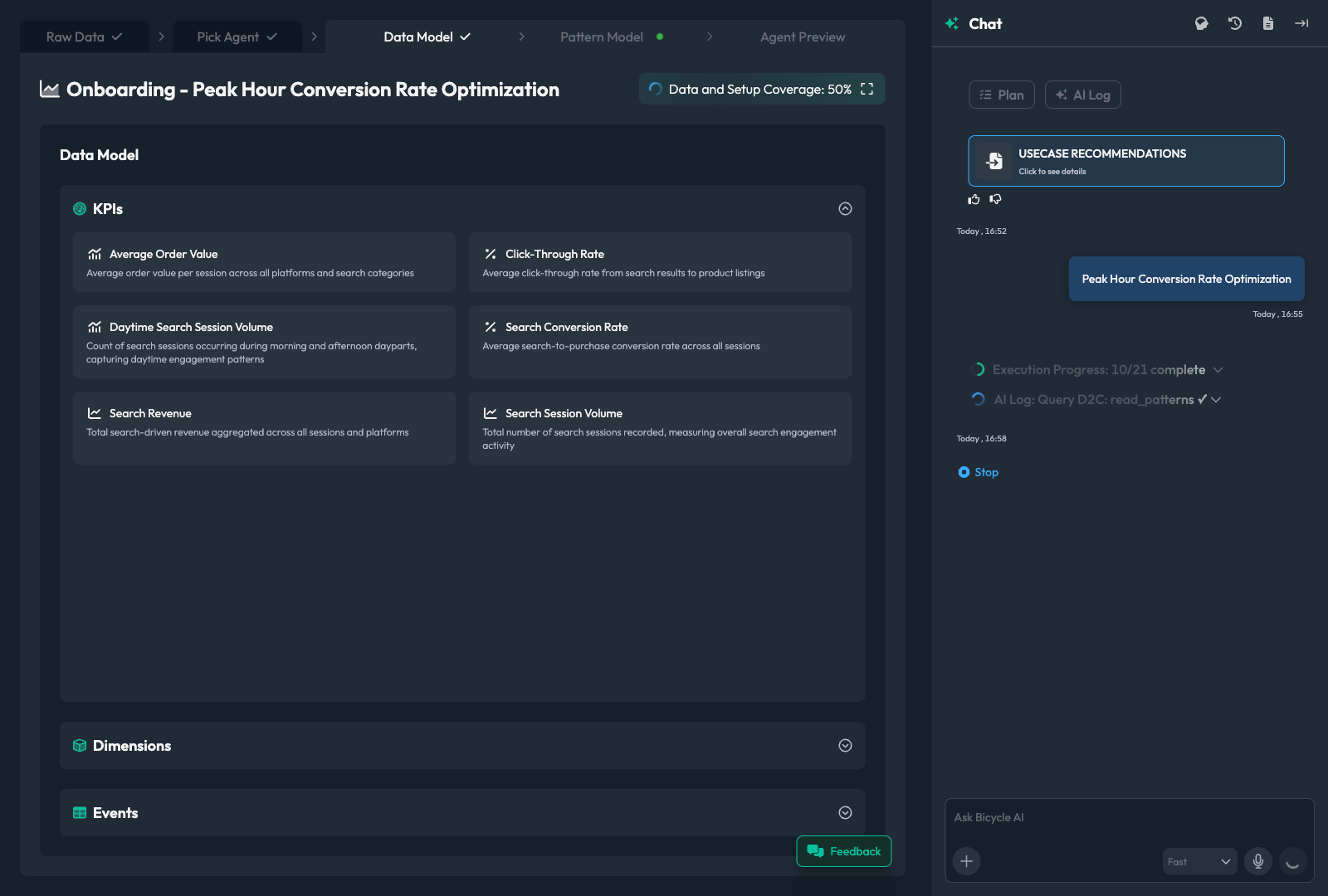
Bicycle drafts your payments data model, the approval, decline, and settlement KPIs, and dimensions from your stack, each one validated against your data. You review, correct, and confirm.
Connect your sources Warehouse, app and web events, payments, product analytics, connected once.01 / 03
From source data to a reusable business model
12345
Connect sources
Bring in your data from across your stack.
Warehouse
Event streams
Databases
Files (CSV, Parquet)
Auto-discover & suggest
Bicycle profiles the data and suggests the business map.
Events
Dimensions
KPIs
Cohorts
Enrich with context
Add business context to improve accuracy.
Screenshots
Documents
Text / Notes
URLs
Build your model
Import existing semantic models, or build from scratch.
Import from dbt
Import from Tableau
OR
Build from scratch
Review & activate
Review mappings, validate, resolve gaps, activate.
Review mappings
Validate KPIs & data
Resolve gaps
Activate
AI-assisted coverage: We map 70–80% of your business data automatically from structure, naming, and patterns.You review, refine, and approve.
Bicycle drafts the KPIs with definitions, you review each one
Review and certify the governed agent before it publishes
Pillar 02Tune the intelligence layer

Tune what it watches and what it checks.
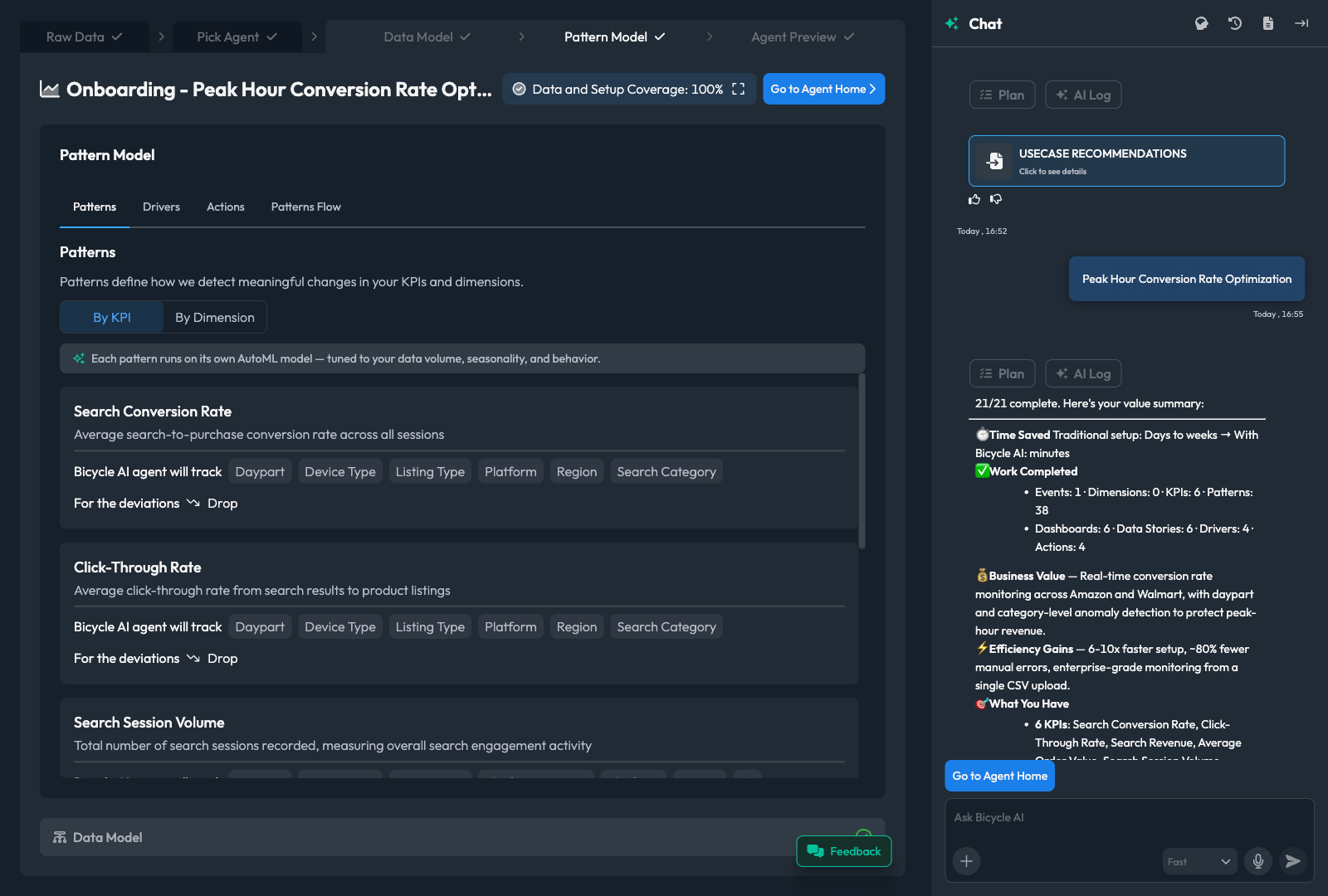
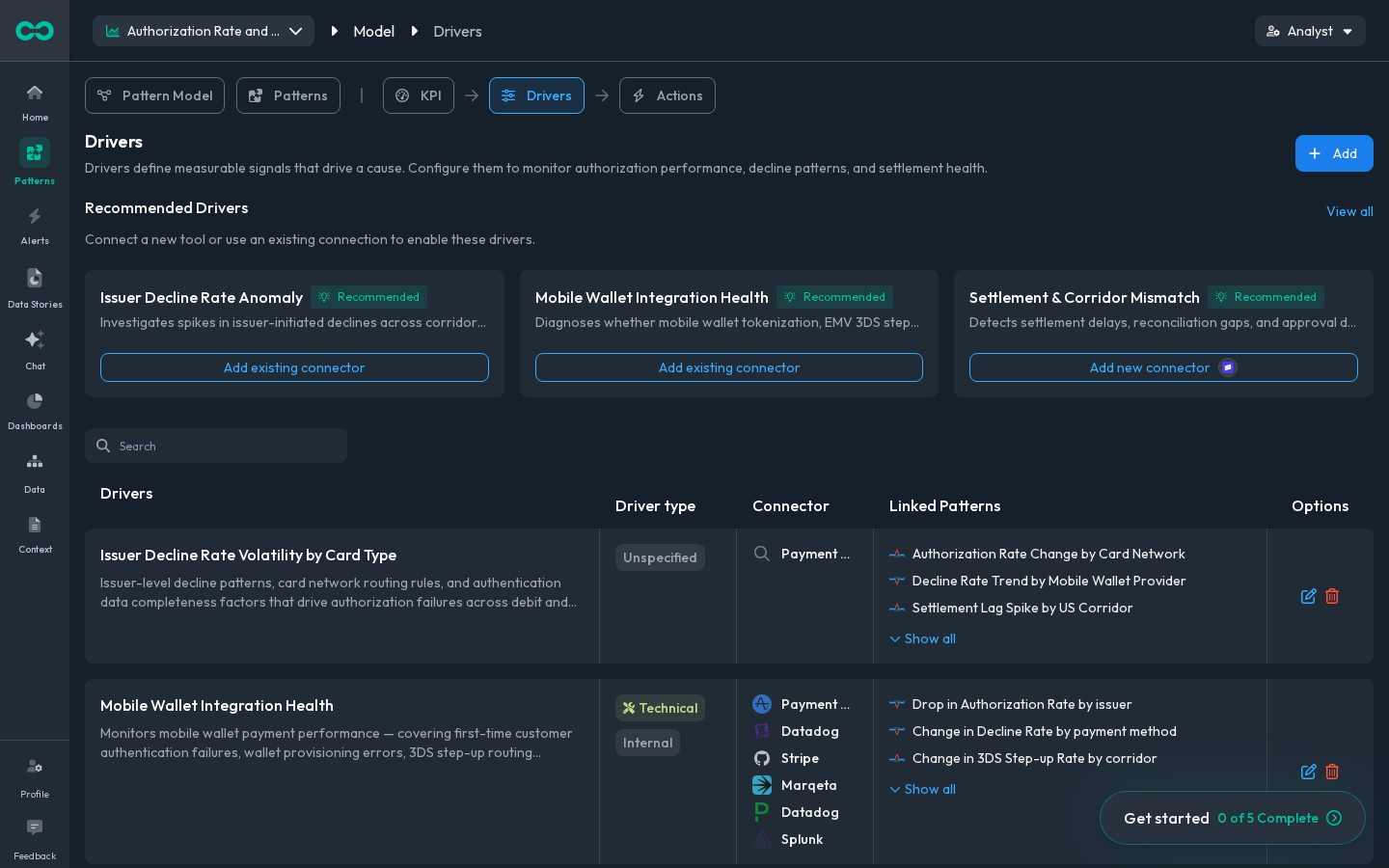
Two engines decide every answer: patterns set what to detect, drivers set what gets checked when approval rate moves. You tune both.
Two engines, both yours Patterns decide what to detect; drivers decide what gets checked when it moves.01 / 03
CONNECTED TO YOUR CONTEXT, NOT JUST THE KPILogsTracesSession & UXCode & configTicketsDocsExternal contextCause engineAUTO-WIRED DRIVERSCause connectorsWhat Bicycle producesIssuer / BIN cohortsMCC & risk scoringCheckout & paymentsGateway & routingSupplier / issuer / partnerLatency / errors / releasesApproval & settlement dataLogsSession replayObservabilityTickets & incidentsExternal signalsDeployments & flagsRunbooks / docsPrimary causeContributing causesWhat we checkedEvidence & source linksRecommended next stepBicycle suggests the driver map automatically. Teams connect the right cause sources, review the evidence, and refine the logic over time.
Set the patterns Bicycle watches
Add the drivers that explain a move
Pillar 03Govern self service and safe actions

Decide who sees what, and what the agent can do.
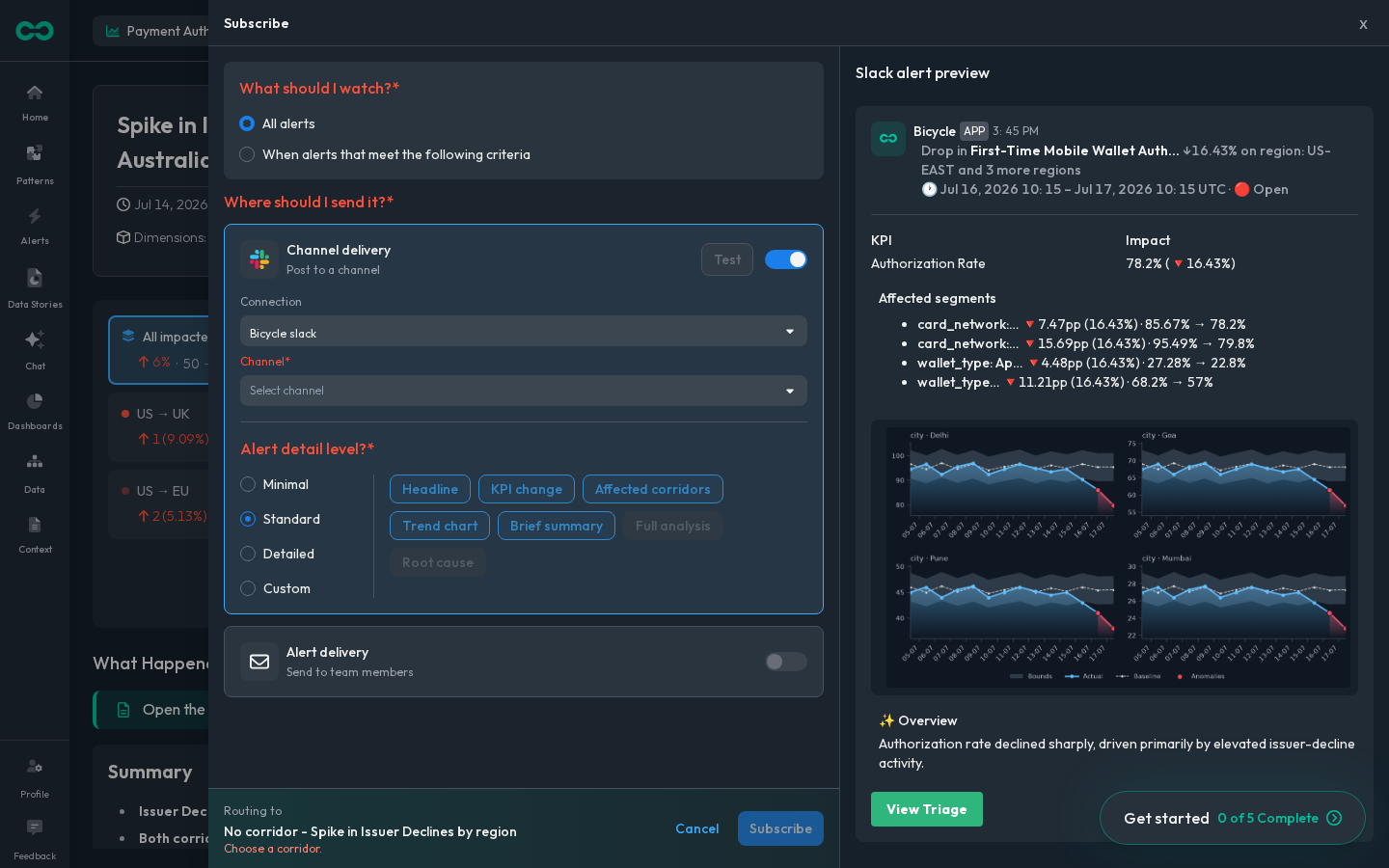
Payment ops gets answers without raw access. You set the permissions, subscriptions, and actions Bicycle may take. Self-service runs inside the boundary you draw.
Set role-based access Which agents each team sees, down to the KPIs, dimensions, and segments at the ontology level.01 / 03
SELF-SERVICE RUNS INSIDE THE BOUNDARY YOU DRAWYOU SET THE BOUNDARYSELF-SERVICE, SCOPED BY ROLEBusinessSubscribe · Request · AskRevenue KPIs in their region & channelAnalystRun · Subscribe · RequestAll KPIs · drivers · segmentsModelerRun · Approve · Publish · EditModel · definitions · governanceTHE BUSINESS GETS ANSWERS, NOT RAW ACCESSAlertsDashboardsData storiesChatRaw dataPASS THE GUARDRAIL GATESlack alertAUTOJira ticketAUTOPause Google AdsAPPROVALRemove supplierAPPROVALpreviewed · approved · bounded · reversible · logged · every answer and action carries who, what, and why.
Route alerts and data stories to the teams that own each KPI
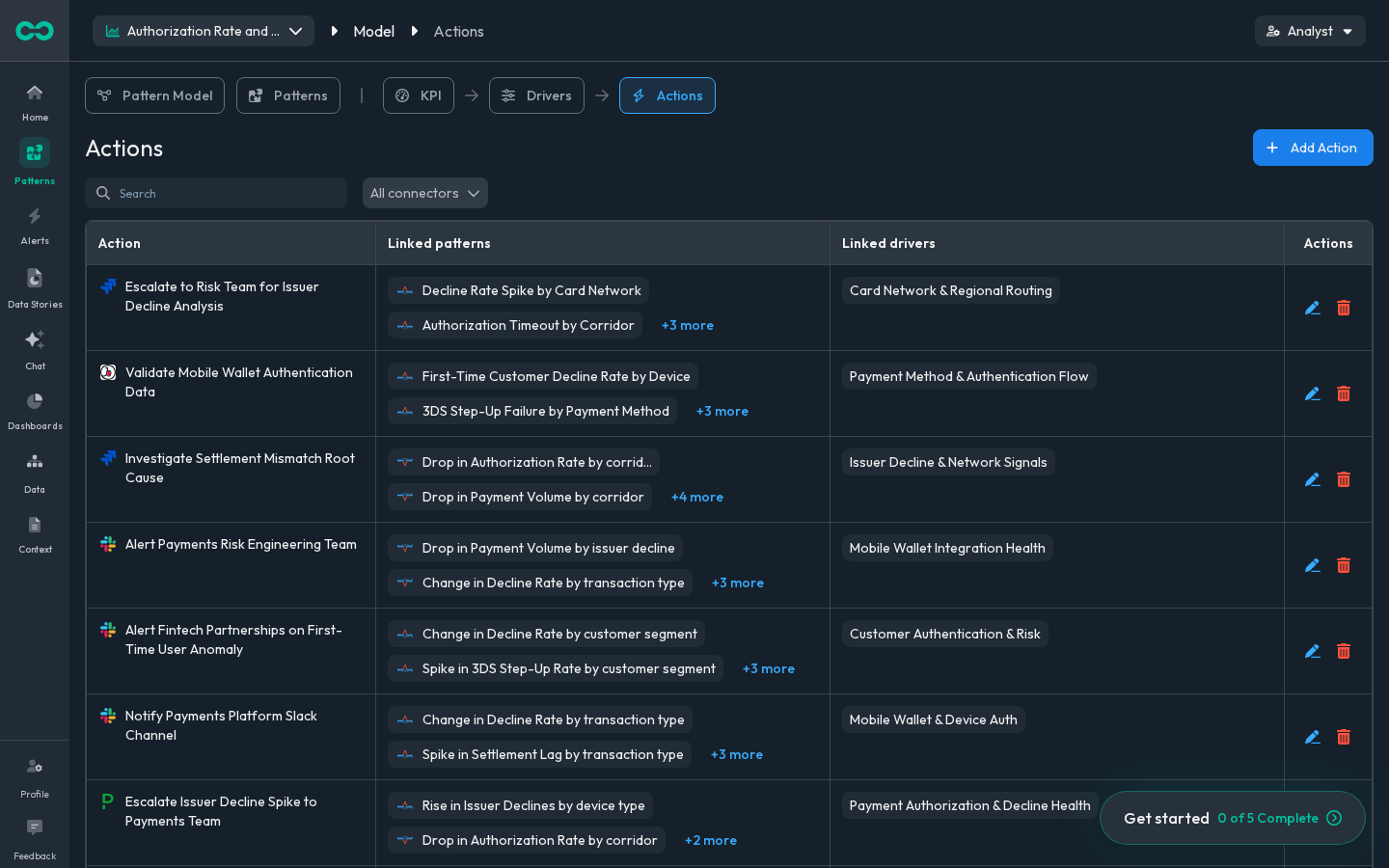
The action catalog, linked to patterns and causes, scoped and logged
A day in the lifeFirst pass by Bicycle · the call is yours
Retail investigation queue

The morning review starts with the first pass done.

Approval rate dropped on one acquirer. Bicycle has already checked the segments, ranked the likely causes, attached the evidence, and kept the definition governed. Your team reviews the answer, publishes the story, and tunes what should happen next time.

Approval rate · Acquirer B · EU debitTop segment below baseline. Affected segment and evidence already assembled for analyst review.
8:42 AM-1.8ppreview queue
Retail investigation queue8:42 AM↓ -1.8ppreview queue
Queue · alerts needing review
HighApproval rate droppedAcquirer B · EU debit2.3%-1.8pp vs baselineTop segmentAcquirer B · EU debit$58Kat riskPayment ops + Riskowning team8:42 AM
MedAdd to cart rate downAll devices · Paid traffic5.6%-0.7pp vs baselineTop segmentPaid traffic · US$31Kat riskGrowth Marketingowning team8:15 AM
MedPayment success rate downAll devices · Credit cards92.1%-1.2pp vs baselineTop segmentCredit cards · US$44Kat riskPaymentsowning team7:02 AM
LowInventory in-stock droppedShoes · 3 warehouses94.3%-0.3pp vs baselineTop segmentShoes · West region$12Kat riskInventoryowning team6:55 AM
+ 4 alerts · 1 high · sorted by revenue at risk
SnoozeOpen investigation
Approval rate · root cause analysisfirst pass by Bicycle↓ -1.8pp
Triaged to one segment · Acquirer B · EU debit
2.3% conversion
baseline 4.1% · ▼1.8pp · returning users · high volume
1 of 6 segments affected · 5 within expected range
Likely driversranked · confidence
MCC risk re-scoring, thresholdsprimary81%
Routing rule drift, EU debitsecondary47%
Fraud spikeruled out
Recommended actionsscoped
Create a ticket on Jirascoped
Alert #retail-revenue on Slackscoped
Update routing rule, EU debitpreview
scoped · previewed · reversible · logged
+ Detected 8:42 · first pass 8:43 · top segment Acquirer B · EU debit
Adjust modelApprove & publish
Validate evidence · Acquirer B · EU debit8:42 AM↓ -1.8ppreview more
Impact overview
2.3%
conversion rate · -1.8pp vs baseline 4.1%
1.24Maffected users
5.83Msessions
Top affected segments
1
Acquirer B · EU debit · US
-1.8pp
2
Acquirer B · EU debit · EU
-1.2pp
3
Acquirer B · high-volume merchants
-0.9pp
Evidence attached
Funnel trendPDP to purchase
Channel mixpaid vs organic
Issuer cohortapproved vs declined
Routing changeEU debit @ 2:15 AM
Ruled out · not drivers
Price changesno overlap with window
Promo changeseligibility unchanged
Fraud spikeunchanged
New vs returningboth affected equally
Definition governed · Source read-only · sources fresh
+ Reviewed by analyst on duty · 8:51 AM
Send backConfirm evidence
Publish answer · approval rate8:42 AM↓ -1.8pppublish
Your conclusion84% confidence
Approval rate dropped on Acquirer B for EU debit, primarily driven by merchant category risk re-scoring that tightened MCC thresholds. Routing rule drift on EU debit is a secondary contributor.
Recommended next steps
1Update the routing rule to fall EU debit back to Acquirer A.
2Monitor approval rate and decline reasons by acquirer.
3Re-balance routing and set an approval-rate guardrail.
Attach & sharegoverned
Impact summary
Evidence bundle
Next steps
Share with
Ecom leadershipEcommerce OpsGrowth Marketing+2
+ Published to Slack · #retail-revenue · 8:54 AM
Save draftApprove & publish
Reused next time · operating memoryToday 7:28 AM↓ -1.6ppauto-applied
Similar situation detected: Approval rate dropped · Acquirer B · EU debit
Bicycle applied your approved playbook.
Detected pattern
Approval-rate drop
Applied playbook
acquirer approval rate
Likely driver
MCC risk re-scoring
Recommended action
Update routing rule
Caught 74 min earlier · 7:28 AM vs 8:42 AM on the first run
No re-investigation · pattern auto-applied, analyst review optional
+ Memory: acquirer approval-rate playbook · run 2
ReviewView playbook
More roles on Bicycle · same loopYour team's KPI · your screens

Different teams own different metrics. Bicycle keeps the investigation governed.

Move from this payments analyst view to the data engineering team that keeps the same approval-rate answer trusted as it scales.

Payments
Payments AnalyticsApproval rate and the recurring investigation · you are here
Payments Data EngineeringRate and pipeline trust: real movement vs artifact
Vibe Analytics

Build your first governed investigation.

Start with one recurring metric in your queue: why checkout conversion, payment success, or activation moved. Bicycle watches the governed KPI, checks likely causes across the warehouse, payments, app & web, and events, and hands your team a reviewable first pass.

What to bring
A recurring investigation: checkout conversion, payment success, search conversion, or activation rate.
An approved read-only path to the relevant sources: the warehouse, event streams, app & web, payments, or ad networks.
The KPI definition, default segments, and reviewers who decide what becomes trusted.
What we do
Configure the investigation path around your KPI, segments, and evidence rules.
Monitor device, OS, channel, region, and segment movement.
Prepare a first-pass cause analysis with evidence, ruled-out paths, and governed definitions.

No credit card required · analyst-reviewed · governed from day one